
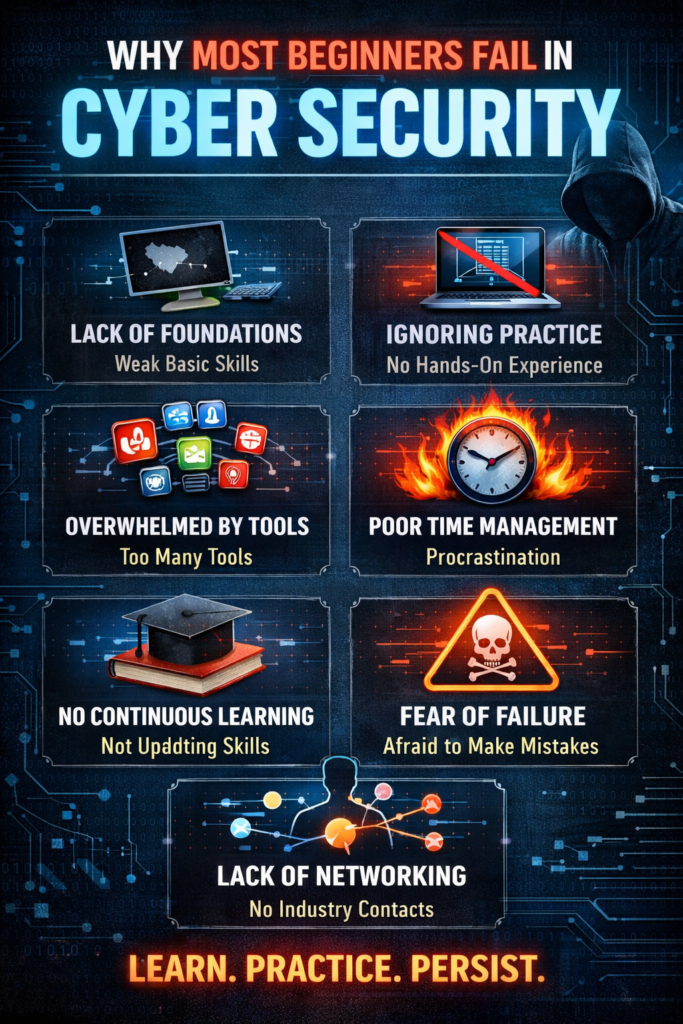
Why Most Beginners Fail in Cyber Security – The Reality of Starting in Cyber Security in 2026
Many beginners enter cyber security with high expectations but often give up within a few months. The main reason is not lack of intelligence, but lack of direction. Without a clear roadmap, it becomes easy to feel lost and overwhelmed.
Common Mistakes Beginners Make
Most beginners focus too much on tools without understanding the basics. They jump into hacking tools without learning networking or operating systems. Another major mistake is inconsistency – learning for a few days and then stopping.
The Right Way to Learn Cyber Security
To succeed, you need to build a strong foundation first. Start with networking, Linux, and basic security concepts. Once your basics are clear, move to practical tools and labs.
Stay Consistent and Practice Daily
Cyber security is a skill-based field. The more you practice, the better you become. Even 1-2 hours daily can create a huge difference over time.
Conclusion
Success in cyber security is not about talent, it’s about consistency and the right direction. Avoid common mistakes, stay focused, and you’ll build a strong career.
The Road Ahead
Why most beginners fail in cyber security comes down to one thing – they give up too early. Every expert you look up to today was once a confused beginner who had no idea where to start. The difference between those who made it and those who quit is simple – they kept going even when progress felt slow. Understanding why most beginners fail in cyber security is the first step to making sure you do not become one of them. They spent nights reading documentation, failed labs over and over, and still showed up the next day. You do not need to know everything at once. You just need to take one step every single day – whether that is watching one video, solving one CTF challenge, or reading one article. This is exactly why most beginners fail in cyber security – they want results fast but consistency is what actually builds real skill. Over months and years, those small steps compound into real, solid expertise. So stop waiting for the perfect course, the perfect time, or the perfect setup. Start now, stay consistent, and trust the process – because the version of you one year from now will thank you for not giving up today.
Why most beginners fail in cyber security is simple – they quit before they even get started properly. Every expert you see today was once exactly where you are right now, confused and overwhelmed with no clear direction.
Understanding why most beginners fail in cyber security helps you avoid the same trap. Stop jumping from tool to tool. Build your basics first – networking, Linux, and core security concepts – and everything else will start to make sense.
Consistency is the real answer to why most beginners fail in cyber security. You do not need 8 hours a day. Just 1 to 2 hours of focused daily practice will take you further than you think over time.
The cyber security world is growing fast and opportunities are everywhere. Start today, stay consistent, trust the process – and one year from now you will be glad you never gave up.
Remember, why most beginners fail in cyber security is not because they lack intelligence or talent – it is because they lose patience and give up too soon. This field is not built overnight. Every small step you take today is building the foundation of your future career. Stay consistent, keep practicing daily, trust your journey, and never stop learning. Your breakthrough in cyber security is much closer than you think – just do not quit.
Why do most beginners fail in cyber security?
Most beginners fail in cyber security because they skip the basics and jump directly to advanced tools. Lack of consistency and proper guidance also makes learning difficult.
Is cyber security hard for beginners?
Cyber security can feel challenging at the start, but with the right roadmap and regular practice, it becomes much easier to understand and learn.